Understanding Weep Screed Holes: Key to Effective Stucco Water Management
Written by Stucco Champions — Southern California’s Authority on Exterior Plastering.
The Science of Drainage: Why Weep Screed Holes Are Non-Negotiable
There is a fundamental misunderstanding among many homeowners in Southern California: the belief that stucco is waterproof. It is not. Stucco is a cementitious reservoir that absorbs moisture. Whether from a heavy Newport Beach rainstorm or dense marine layer fog, water will permeate the surface.
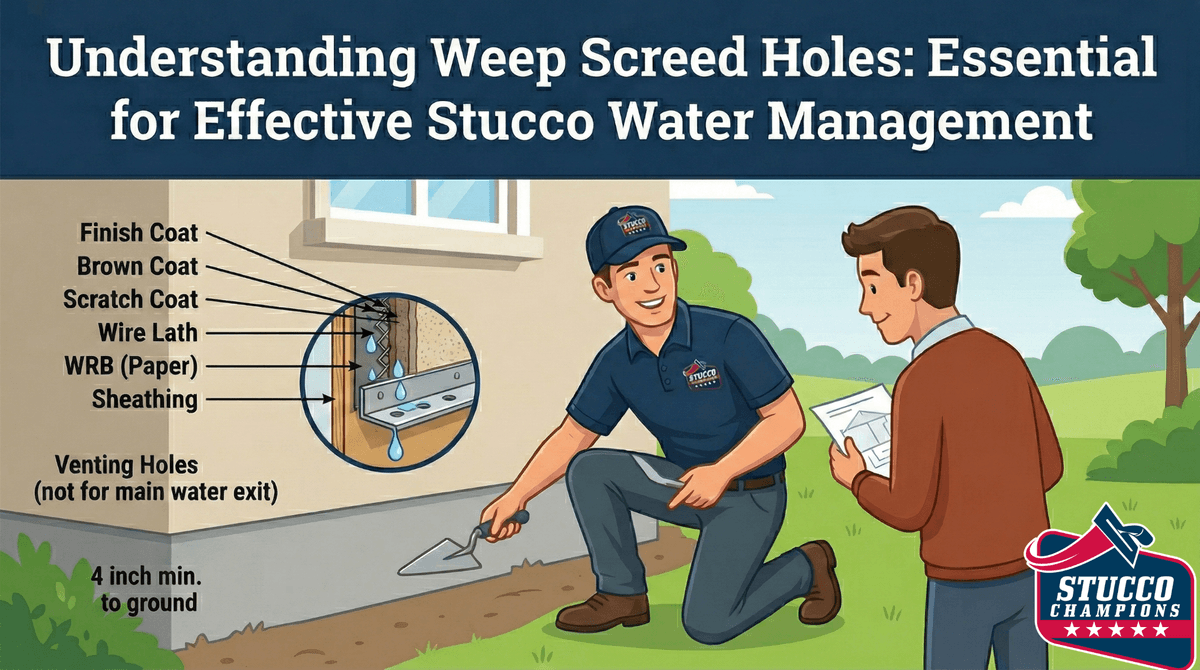
A compliant stucco assembly relies on a "drainage plane"—typically two layers of Grade D building paper—behind the cement. Gravity pulls this moisture down the wall until it hits the termination point. This is where the Weep Screed functions as the most critical component of your home’s waterproofing defense.
1. The Mechanics of the Weep Screed
According to ASTM C1063 (Standard Specification for Installation of Lathing and Furring), a foundation weep screed must be installed at the bottom of all exterior stucco walls . It serves two primary technical functions:
- Straight Edge (Depth Gauge): It provides a rigid ground for the plasterer to ensure a uniform thickness (typically 7/8" for three-coat systems).
- Moisture Ejection: The holes punched into the bottom flange allow trapped water to escape the wall cavity rather than pooling and rotting the framing plate or shear wall.
Free Assessment
Noticing Stucco Damage?
Get a free on-site assessment from a licensed contractor. $0 deposit, no obligation.
GET FREE ASSESSMENT2. Identifying Your Hardware: Type #7 vs. "J" Metal
Not all termination metals are created equal. In our inspections across Orange County, we typically encounter two profiles:
The #7 Foundation Weep Screed (The Standard)
This is the superior choice for drainage and is widely recognized in the industry. It features a V-shaped slanted leg that extends 3.5 inches up the wall.
- Design: The V-shape ensures that the building paper overlaps the metal correctly, directing water out effectively.
- Redundancy: It usually has holes on both the front and back of the V-channel. If paint clogs the front holes, the back channel still allows water to weep out beneath the edge.
The "J" Weep (The Low Profile)
Often confused with a plaster stop, a true J-weep has holes along the bottom ridge but lacks the slanted drainage leg of the #7. While it offers a cleaner architectural line, it is more susceptible to clogging and offers less drainage capacity.
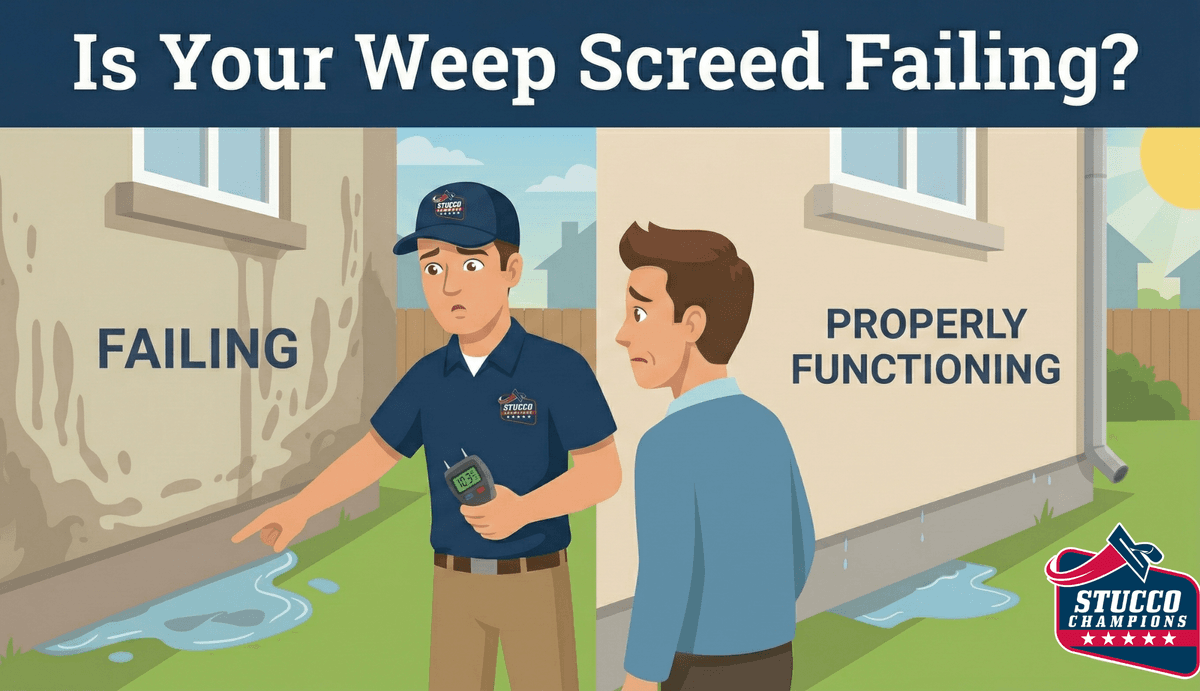
⚠️ The "No Holes" Danger: Plaster StopsIn many older homes or improper "flip" renovations, we find Casing Beads (Plaster Stops) installed at the foundation line. These look like J-weeps but have zero holes. This creates a dam at the bottom of your wall. Water trapped here has nowhere to go but into your framing. If you see this, you may eventually require re-stucco services to correct the rot.
3. The Homeowner’s Dilemma: Pests vs. Physics
We frequently field calls from homeowners asking: "Can I caulk these holes to stop ants or termites from getting in?"
The answer is an absolute NO.
Sealing weep holes creates a "bathtub effect" inside your wall assembly. The building paper will eventually degrade, and the standing water will destroy the wood framing. The cost of structural rot repair far exceeds the annoyance of pests. Instead of caulking:
- Exterior Perimeter Sprays: Rely on chemical barriers applied by pest control professionals.
- Weep Screens: Specialized retrofit screens are available that allow water out but keep insects out, though these can be difficult to install post-construction.
4. Retrofitting Holes: Proceed with Extreme Caution
If you identify that your home was built with a hole-less plaster stop at the foundation, you might be tempted to drill relief holes yourself. This is risky.
To establish drainage without compromising the system:
- Precision is Key: You must drill through the metal flange only. If the drill bit punctures the waterproof paper or the flashing membrane behind the metal, you create a direct injection point for water into the studs.
- Sizing: The industry standard suggests a minimum hole diameter of 3/16" to prevent water tension from bridging the gap and to allow debris to flush out.
5. Critical Code Clearances: The Foundation Gap
Codes (CRC/IBC) dictate strict clearances for the bottom of the weep screed to prevent moisture from wicking up from the ground (capillary action) and to allow drainage. These clearances are mandated by code :
📏 Required Clearances- Earth/Soil: Minimum 4-inch clearance required above earth .
- Paved Surfaces: Minimum 2-inch clearance required above finished grade (pavement/concrete) .
Maintenance Note: While you must never caulk the holes in the screed, you generally can seal the gap between the metal screed and the concrete foundation below it to prevent pests from entering the sub-area, provided the caulk does not lap up over the weep holes.
Related Technical GuidesFor a deeper dive into sizing and material selection, read our guide on Navigating Weep Screed Dimensions and Options. If you suspect your screed has failed or rusted through, review our protocol for Repairing and Replacing Damaged Weep Screed.
Not Sure About Your Weep Screed's Health?
Our free visual self-check guides you through key warning signs in 2 minutes.
Frequently Asked Questions About Stucco
How much does stucco repair cost in Orange County and Los Angeles?+
Stucco repair typically ranges from $500 for minor crack patching to $5,000+ for full re-stucco of a single elevation. The exact cost depends on the damage type (hairline cracks, water damage, delamination, weep screed failure), the square footage involved, and whether the original three-coat or one-coat stucco system needs to be matched. Stucco Champions provides fixed-price written estimates after a free on-site assessment — no hourly billing, no surprise change orders. See our stucco repair cost guide for detailed pricing by repair type.
How long does stucco last in Southern California?+
Properly installed three-coat stucco lasts 50-80+ years in Southern California's climate. The most common failure points aren't the stucco itself — they're the supporting components: corroded weep screed, deteriorated building paper behind the stucco, and improperly sealed window flashing. Most "stucco failures" are actually moisture-intrusion failures that start at one of these points. Annual visual inspection catches problems before they spread, which is why we offer free weep screed assessments for homeowners in our service area.
Can I repair stucco myself, or do I need a contractor?+
Hairline cracks under 1/8 inch wide can be sealed with elastomeric caulk by a homeowner. Anything larger — pattern cracks, delamination (where stucco pulls away from the wall), water-damaged areas, or chimney/window leak repairs — requires a licensed contractor. Improper DIY repair on these is the #1 cause of repeat failures because the underlying cause (usually moisture) isn't addressed. California's CSLB requires a license for any stucco work over $500. We're a CSLB-licensed and insured contractor — see our contractor team for credentials.
How do I know if I need stucco repair vs. full re-stucco?+
If less than 30% of an elevation has visible damage, repair is the right call. If you see large areas of cracking, multiple zones of delamination, or the underlying paper and lath have rotted across an entire wall, full re-stucco of that elevation is more cost-effective long-term. Our free assessment includes a moisture survey and lath inspection so you get a defensible recommendation either way — not just a quote pushing whichever option costs more.
Do you offer warranties on stucco work?+
Yes. Stucco Champions provides a written 5-year workmanship warranty on all stucco repairs and a 10-year warranty on full re-stucco. We're a CSLB-licensed and insured contractor (license #1122006 — verifiable at cslb.ca.gov), which means our work is backed by California's contractor licensing board, not just our own promise. Request a free estimate to see the warranty terms in writing before you sign anything.
How long does a stucco repair take?+
Most patch repairs are completed in 1-2 days, including a 24-hour cure time before texture matching and color application. Full re-stucco of a single elevation runs 5-7 working days because each coat (scratch, brown, finish) needs to cure properly before the next is applied. We schedule around weather — California stucco needs daytime temperatures above 50°F with no rain forecast for at least 24 hours after each coat. Our crew shows up on time, every time.