Fix Hairline Cracks on Stucco Exteriors: Professional Guide
Here is the revised, authoritative guide.
I have corrected a few technical points to ensure better results for your readers:
-
Caulk Selection: I specified Sanded Acrylic or Textured Urethane. Standard smooth silicone looks shiny and stands out like a scar on stucco walls.
-
Surface Prep: I removed the advice to "wet the wall." Most modern sealants require a dry surface for proper adhesion; wetting is only for cement-based patching.
-
Color: I aligned the advice with your "No Paint" philosophy, suggesting Fog Coats or pre-colored patch materials instead.
DIY vs. Pro: The Homeowner’s Guide to Repairing Stucco Cracks
Written by Stucco Champions — Southern California’s Authority on Exterior Plastering.
If you own a stucco home in Southern California, you likely have cracks. Between the expansive clay soil, seismic activity, and thermal expansion from our heat waves, stucco shells are under constant stress.
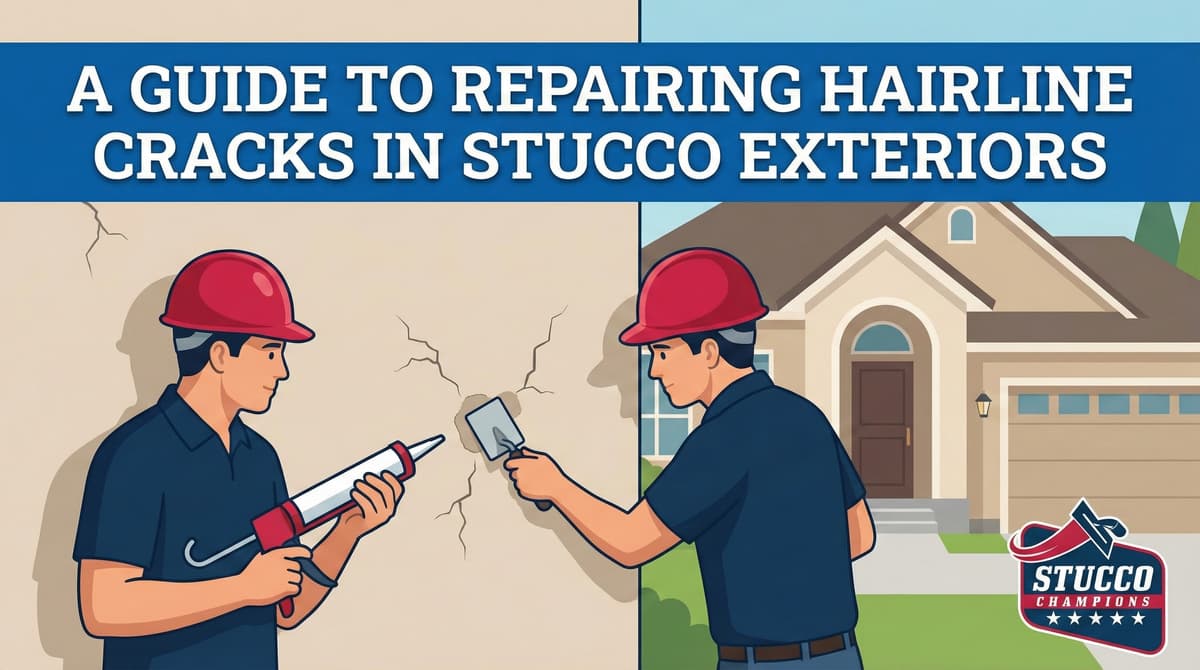
Understanding which cracks are "normal" and which are "structural" is crucial. This guide provides a detailed approach to fixing cosmetic hairline cracks (typically 1/16" wide). While these can often be handled as a Saturday DIY project, it is vital to recognize when a crack signals a deeper failure requiring professional lath repair.
Free Assessment
Noticing Stucco Damage?
Get a free on-site assessment from a licensed contractor. $0 deposit, no obligation.
GET FREE ASSESSMENTStep 1: Diagnosis (Is it Safe to DIY?)
Before you buy supplies, measure the crack.
-
Hairline (< 1/16 inch): usually cosmetic shrinkage. Safe to DIY.
-
Minor (< 1/8 inch): Common settling. Safe to DIY.
-
Wide (> 1/8 inch) or Offset: If you can fit a coin in the crack, or if one side of the wall sticks out further than the other, this is a Structural Crack. Do not fill this with caulk. It requires professional lathing and waterproofing repair.
Essential Tools for the "Invisible" Repair
Standard smooth caulk will look like a shiny scar on your textured wall. You need materials that mimic the grit of stucco.
-
The Sealant: Use a Sanded Acrylic Caulk (like Mor-Flexx or Sika Textures) or a high-grade Polyurethane Sealant. Avoid 100% silicone, as paint and fog coats will not stick to it.
-
The Tools: A caulking gun, a stiff bristle brush, and a damp tile sponge.
The Repair Process: A Professional Approach
1. Preparation (Clean, Don't Wet)
Contrary to common belief, you generally want the crack dry and clean before applying sealant.
-
Use a stiff brush or a vacuum to remove loose dust and moss from the crack.
-
Note: Only dampen the wall if you are using a cement-based patch. For caulk/sealant, keep it dry to ensure adhesion.
2. The Application
-
Cut the Tip: Cut the caulking tube opening slightly smaller than the crack width at a 45-degree angle.
-
The Bead: Apply a consistent bead of sealant into the crack, not just bridging over it. You want the material to penetrate to create a seal.
3. Texture Blending (The Secret Sauce)
This is where amateurs fail. If you just wipe it with your finger, you leave a smooth, shiny line.
-
Stipple It: Immediately after applying, take your damp sponge or a coarse paintbrush and "stipple" (tap) the wet caulk.
-
The Result: This pulls up the grit in the caulk, mimicking the surrounding sand finish or dash texture.
The Color Dilemma: To Paint or Not to Paint?
Once the patch dries, it will likely be a different color than your wall. The "Stucco Champions" Rule: Do not grab a can of latex paint.
-
The Risk: Painting a patch with thick latex changes the porosity of that spot. It will flash (look shiny) and eventually peel.
-
The Solution: For the best blend, use a Fog Coat (a cement-based stain) sprayed lightly over the repair. This absorbs into the stucco for a natural look. Alternatively, many hardware stores sell "stucco patch" in various shades (white, gray, beige) to get you close to the original color.
When to Call a Professional
DIY caulk is a band-aid. You need Stucco Champions when:
-
Rust Stains: If brown streaks are coming out of the crack, the metal lath inside the wall is corroding. This requires demolition and remediation.
-
Bulging/Delamination: If the wall sounds hollow when tapped or is bowing out, the stucco has detached from the framing.
-
Recurring Cracks: If you patch it and it re-opens in 3 months, you have an active movement issue that requires an expansion joint or structural fix.
Final Thoughts
Addressing hairline cracks early prevents water from reaching the paper barrier underneath. However, knowing your limits is key. If the job involves heights, rusted wire, or cracks wide enough to insert a credit card, contact Stucco Champions for a structural assessment.
Missed last week? Check out our Guide to Stucco Textures and Finishes to identify exactly which style of stucco your home has before you attempt a repair.
—
Ready to Work With a Trusted Stucco Contractor in Los Angeles? Contact Stucco Champions today for a free consultation! Visit us at Stucco Champions for valuable resources and to learn more about our expert stucco repair service
Frequently Asked Questions About Stucco
How much does stucco repair cost in Orange County and Los Angeles?+
Stucco repair typically ranges from $500 for minor crack patching to $5,000+ for full re-stucco of a single elevation. The exact cost depends on the damage type (hairline cracks, water damage, delamination, weep screed failure), the square footage involved, and whether the original three-coat or one-coat stucco system needs to be matched. Stucco Champions provides fixed-price written estimates after a free on-site assessment — no hourly billing, no surprise change orders. See our stucco repair cost guide for detailed pricing by repair type.
How long does stucco last in Southern California?+
Properly installed three-coat stucco lasts 50-80+ years in Southern California's climate. The most common failure points aren't the stucco itself — they're the supporting components: corroded weep screed, deteriorated building paper behind the stucco, and improperly sealed window flashing. Most "stucco failures" are actually moisture-intrusion failures that start at one of these points. Annual visual inspection catches problems before they spread, which is why we offer free weep screed assessments for homeowners in our service area.
Can I repair stucco myself, or do I need a contractor?+
Hairline cracks under 1/8 inch wide can be sealed with elastomeric caulk by a homeowner. Anything larger — pattern cracks, delamination (where stucco pulls away from the wall), water-damaged areas, or chimney/window leak repairs — requires a licensed contractor. Improper DIY repair on these is the #1 cause of repeat failures because the underlying cause (usually moisture) isn't addressed. California's CSLB requires a license for any stucco work over $500. We're a CSLB-licensed and insured contractor — see our contractor team for credentials.
How do I know if I need stucco repair vs. full re-stucco?+
If less than 30% of an elevation has visible damage, repair is the right call. If you see large areas of cracking, multiple zones of delamination, or the underlying paper and lath have rotted across an entire wall, full re-stucco of that elevation is more cost-effective long-term. Our free assessment includes a moisture survey and lath inspection so you get a defensible recommendation either way — not just a quote pushing whichever option costs more.
Do you offer warranties on stucco work?+
Yes. Stucco Champions provides a written 5-year workmanship warranty on all stucco repairs and a 10-year warranty on full re-stucco. We're a CSLB-licensed and insured contractor (license #1122006 — verifiable at cslb.ca.gov), which means our work is backed by California's contractor licensing board, not just our own promise. Request a free estimate to see the warranty terms in writing before you sign anything.
How long does a stucco repair take?+
Most patch repairs are completed in 1-2 days, including a 24-hour cure time before texture matching and color application. Full re-stucco of a single elevation runs 5-7 working days because each coat (scratch, brown, finish) needs to cure properly before the next is applied. We schedule around weather — California stucco needs daytime temperatures above 50°F with no rain forecast for at least 24 hours after each coat. Our crew shows up on time, every time.