Stucco Paper Types: A Comprehensive Guide
Written by Stucco Champions — Southern California’s Authority on Exterior Plastering.
The Defense Line: A Technical Guide to Stucco Paper (Grade D)
There is a saying in the trade: "The stucco is for looks; the paper is for leaks."
Because stucco is a porous reservoir that absorbs water, the Weather-Resistive Barrier (WRB) behind it is your home's only true defense against rot. However, confusion surrounds the different "grades" and "layers" required by code. This guide demystifies 10-Minute vs. 60-Minute paper and explains why the "Two-Layer Rule" is non-negotiable in California.
1. The Two-Layer Code Requirement
The most common inaccuracy found online is the idea that a single layer of paper is sufficient.
According to the California Residential Code (CRC R703.7.3) and IBC, if you are applying stucco over wood-based sheathing (Plywood or OSB), you generally must install:
- Layer 1: A base water-resistive barrier.
- Layer 2: A "sacrificial" layer that separates the stucco from the first layer.
⚠️ Why Two Layers?
Stucco bonds aggressively to paper. If you use only one layer, the stucco will fuse to it. When the stucco cracks (which it will) and water enters, it has a direct path to the wood. The second layer creates a bond breaker, allowing water to drain down between the two sheets and out the weep screed.
Free Assessment
Noticing Stucco Damage?
Get a free on-site assessment from a licensed contractor. $0 deposit, no obligation.
GET FREE ASSESSMENT2. Understanding the Ratings (ASTM D779)
Building paper is rated by "Minutes." This is based on the ASTM D779 "Boat Test," which measures how long it takes for moisture to permeate the paper.
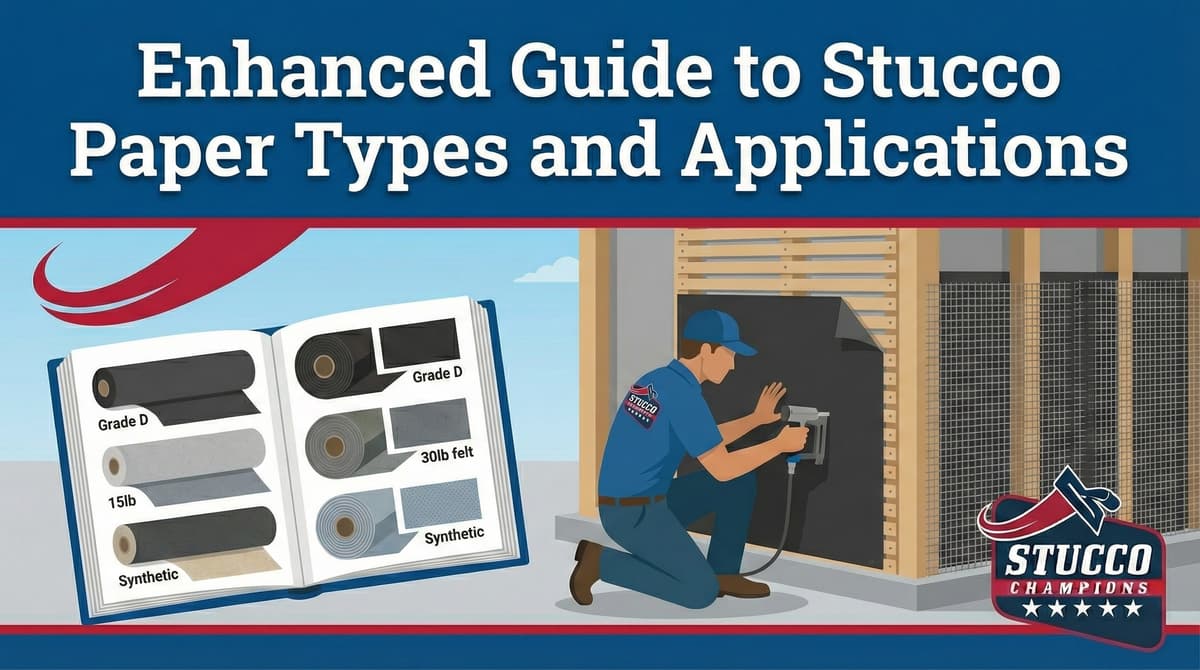
10-Minute Grade D Paper
This is the standard minimum code paper. It is thin, lightweight, and economical.
The Drawback: In wet coastal environments like Huntington Beach or Newport, standard 10-minute paper can degrade quickly if the stucco remains saturated ("reservoir effect"). We rarely recommend this for high-end custom homes.
60-Minute "Super Jumbo Tex"
This is the Stucco Champions Standard. It is significantly heavier, containing more asphalt saturation.
The Benefit: It offers superior holdout against heavy rain and resists tearing during lath installation. While it costs more, it is cheap insurance for your framing.
3. Product Formats: Single-Ply vs. Double-Ply
Do not confuse "Double-Ply" paper with the "Two-Layer" code requirement.
- Single-Ply Rolls: A roll containing one sheet of paper. To meet code over plywood, the crew must wrap the house twice.
- Double-Ply (2-Ply) Rolls: Manufacturers like Fortifiber (Jumbo Tex) create rolls that unspool two distinct layers of paper at once. [Image of 2-ply Jumbo Tex installation] This allows contractors to meet the two-layer code requirement in a single pass, ensuring proper overlap and reducing labor.
4. Housewraps (Tyvek) vs. Building Paper
Can you use Tyvek behind stucco? Yes, but with a major caveat.
Stucco acts like a surfactant (soap), which can break down the surface tension of certain plastic housewraps. Furthermore, stucco will bond to Tyvek, nullifying its drainage capability.
The Hybrid System
If you use Tyvek or a similar housewrap as your primary air/water barrier, you MUST install a layer of Grade D paper (or felt) over it. The paper protects the Tyvek from the cement and creates the necessary drainage gap.
5. Stucco Champions Recommendation
For the longest-lasting exterior in Southern California, we recommend avoiding the bare minimum.
- Best Practice: Two layers of 60-Minute Grade D Paper.
- Alternative: A "Hybrid" system with a high-performance housewrap (like Tyvek StuccoWrap) covered by a layer of 60-Minute paper.
Related Maintenance Guide
Last week, we explored what happens when waterproofing fails in our guide: Comprehensive Guide to Stucco Crack Repair: Options and Considerations. If you are seeing moisture damage, start there.
Frequently Asked Questions About Stucco
How much does stucco repair cost in Orange County and Los Angeles?+
Stucco repair typically ranges from $500 for minor crack patching to $5,000+ for full re-stucco of a single elevation. The exact cost depends on the damage type (hairline cracks, water damage, delamination, weep screed failure), the square footage involved, and whether the original three-coat or one-coat stucco system needs to be matched. Stucco Champions provides fixed-price written estimates after a free on-site assessment — no hourly billing, no surprise change orders. See our stucco repair cost guide for detailed pricing by repair type.
How long does stucco last in Southern California?+
Properly installed three-coat stucco lasts 50-80+ years in Southern California's climate. The most common failure points aren't the stucco itself — they're the supporting components: corroded weep screed, deteriorated building paper behind the stucco, and improperly sealed window flashing. Most "stucco failures" are actually moisture-intrusion failures that start at one of these points. Annual visual inspection catches problems before they spread, which is why we offer free weep screed assessments for homeowners in our service area.
Can I repair stucco myself, or do I need a contractor?+
Hairline cracks under 1/8 inch wide can be sealed with elastomeric caulk by a homeowner. Anything larger — pattern cracks, delamination (where stucco pulls away from the wall), water-damaged areas, or chimney/window leak repairs — requires a licensed contractor. Improper DIY repair on these is the #1 cause of repeat failures because the underlying cause (usually moisture) isn't addressed. California's CSLB requires a license for any stucco work over $500. We're a CSLB-licensed and insured contractor — see our contractor team for credentials.
How do I know if I need stucco repair vs. full re-stucco?+
If less than 30% of an elevation has visible damage, repair is the right call. If you see large areas of cracking, multiple zones of delamination, or the underlying paper and lath have rotted across an entire wall, full re-stucco of that elevation is more cost-effective long-term. Our free assessment includes a moisture survey and lath inspection so you get a defensible recommendation either way — not just a quote pushing whichever option costs more.
Do you offer warranties on stucco work?+
Yes. Stucco Champions provides a written 5-year workmanship warranty on all stucco repairs and a 10-year warranty on full re-stucco. We're a CSLB-licensed and insured contractor (license #1122006 — verifiable at cslb.ca.gov), which means our work is backed by California's contractor licensing board, not just our own promise. Request a free estimate to see the warranty terms in writing before you sign anything.
How long does a stucco repair take?+
Most patch repairs are completed in 1-2 days, including a 24-hour cure time before texture matching and color application. Full re-stucco of a single elevation runs 5-7 working days because each coat (scratch, brown, finish) needs to cure properly before the next is applied. We schedule around weather — California stucco needs daytime temperatures above 50°F with no rain forecast for at least 24 hours after each coat. Our crew shows up on time, every time.