Green Stucco: A Comprehensive Guide for Homeowners
Written by Stucco Champions — Southern California’s Authority on Exterior Plastering.
Nature’s Palette: A Technical Guide to Green Stucco
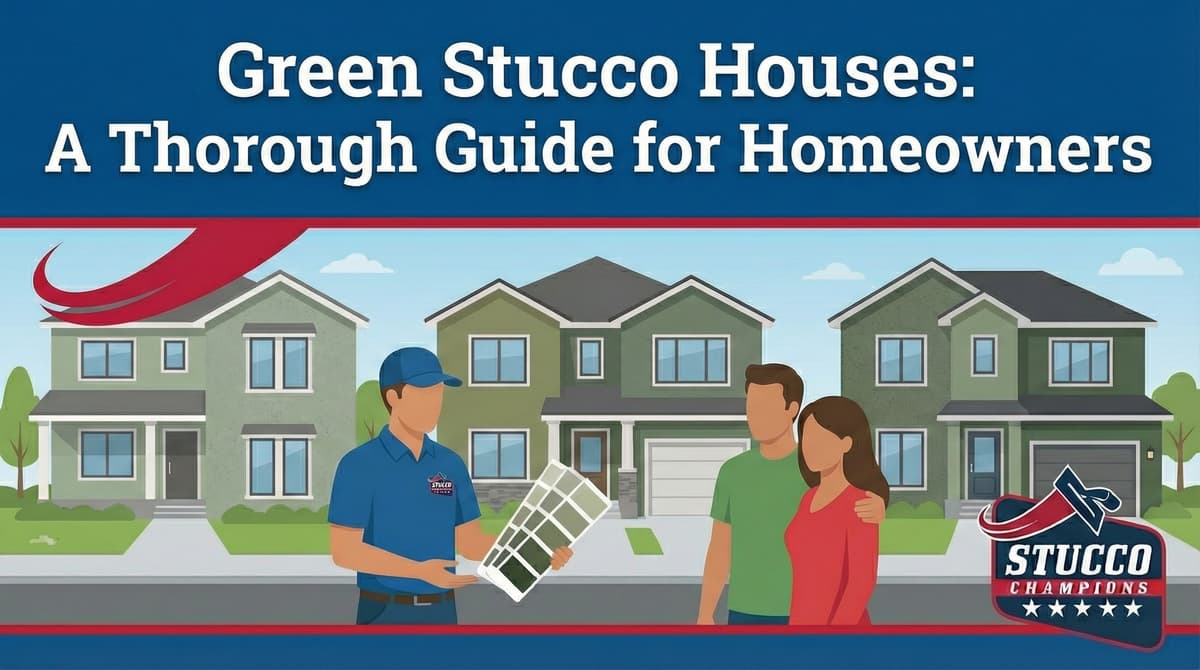
In Southern California, green stucco is a bold, sophisticated choice that allows a home to blend seamlessly with our canyons and coastal sage scrub. From the deep "Forest Green" of a Craftsman bungalow to the subtle "Sage" of a contemporary ranch, green offers a refreshing departure from standard beige.
However, green is one of the most chemically sensitive colors in the masonry world. Specifically, the Chromium Oxide pigments used to create it react differently to UV light and cement alkalinity than other earth tones. This guide covers the material science required to keep your green walls vibrant.
1. The Two Types of Green: Earthy vs. Vibrant
When selecting a green finish, you must categorize your desired look, as this dictates the material we use:
Free Assessment
Noticing Stucco Damage?
Get a free on-site assessment from a licensed contractor. $0 deposit, no obligation.
GET FREE ASSESSMENTThe "Sage/Olive" Spectrum (Earth Tones)
These are muted, grey-based greens.
Chemistry: Created using stable Iron Oxide pigments mixed with standard cement.
Performance: Excellent durability. These colors resist fading and allow for beautiful, natural mottling (color variation) typical of traditional Spanish or Tuscan styles.
The "Forest/Kelly" Spectrum (Vibrant Tones)
These are deep, saturated greens.
Chemistry: Requires higher loads of Chromium Oxide or organic pigments.
Performance: High Risk in Cement. Without polymer modification, these pigments can "burn out" (turn grey) under the SoCal sun within 3-5 years. They are also prone to severe efflorescence (white salt staining) which looks terrible against a dark background.
⚠️ The Material Rule
If you want a Dark or Vibrant Green, we strongly recommend using an Acrylic Finish. Acrylics encapsulate the pigment, protecting it from UV degradation and preventing salt from leaching out. Using traditional cement for dark green is a maintenance gamble.
2. Pairing Green with Hardscape & Trim
Green acts as a neutral in nature, but on a house, it requires specific anchors to avoid looking like a "cartoon house."
- Wood Accents: Dark stained cedar or redwood creates a stunning, organic contrast against Sage or Olive stucco. This is the quintessential "Craftsman" look.
- Stone Veneer: Pair with "Grey" or "Charcoal" stone. Avoid "Tan" or "Gold" stone, as the yellow undertones often clash with the green stucco, making the house look muddy.
- Trim Color:
- Cream/Off-White: Soft, traditional look.
- Bronze/Black: Modern, sharp look.
- Red/Brick: Classic complementary color (think Italian Villa), but use sparingly.
3. The Roof Factor
Your roof is the hat that frames the face of the house.
Terra Cotta / Red Tile: Pairs beautifully with Olive and Moss greens (Mediterranean style).
Charcoal / Slate: Pairs with Cool/Blue-Greens (Modern/Coastal style).
Brown Shake: Pairs with deep Forest tones (Rustic/Cabin style).
4. Maintenance: The Algae Myth
Homeowners often ask: "Will green stucco hide algae/mold?"
Actually, quite the opposite. In shady, North-facing areas (common in damp canyons like Trabuco or Topanga), green algae grows on stucco.
The Problem: Green algae on green stucco just makes the wall look dirty and splotchy.
The Solution: Regular cleaning is required. We recommend a low-pressure "Soft Wash" with a mild fungicide annually to keep the color true.
5. Cost Considerations
Green pigments (Chromium Oxide) are generally more expensive than standard earth pigments (Ochre/Red Iron Oxide).
Budget Expectation
Expect a "Deep Tone" surcharge from material manufacturers (LaHabra/Omega) for dark green finishes. The pigment load is higher, increasing the material cost by roughly 15-20% per bag/bucket compared to standard beige.
Conclusion: Go Green, But Go Acrylic
Green stucco is a sophisticated choice that adds immense curb appeal and value—if done right. To ensure the color stays lush rather than fading to a sickly grey, consult with a professional about using high-performance Acrylic finishes for your project.
Related Resources
Last week, we shared Gray Stucco Homes: A Comprehensive Guide. If green feels too bold, grey offers a similar modern aesthetic with less pigment risk.
Frequently Asked Questions About Stucco
How much does stucco repair cost in Orange County and Los Angeles?+
Stucco repair typically ranges from $500 for minor crack patching to $5,000+ for full re-stucco of a single elevation. The exact cost depends on the damage type (hairline cracks, water damage, delamination, weep screed failure), the square footage involved, and whether the original three-coat or one-coat stucco system needs to be matched. Stucco Champions provides fixed-price written estimates after a free on-site assessment — no hourly billing, no surprise change orders. See our stucco repair cost guide for detailed pricing by repair type.
How long does stucco last in Southern California?+
Properly installed three-coat stucco lasts 50-80+ years in Southern California's climate. The most common failure points aren't the stucco itself — they're the supporting components: corroded weep screed, deteriorated building paper behind the stucco, and improperly sealed window flashing. Most "stucco failures" are actually moisture-intrusion failures that start at one of these points. Annual visual inspection catches problems before they spread, which is why we offer free weep screed assessments for homeowners in our service area.
Can I repair stucco myself, or do I need a contractor?+
Hairline cracks under 1/8 inch wide can be sealed with elastomeric caulk by a homeowner. Anything larger — pattern cracks, delamination (where stucco pulls away from the wall), water-damaged areas, or chimney/window leak repairs — requires a licensed contractor. Improper DIY repair on these is the #1 cause of repeat failures because the underlying cause (usually moisture) isn't addressed. California's CSLB requires a license for any stucco work over $500. We're a CSLB-licensed and insured contractor — see our contractor team for credentials.
How do I know if I need stucco repair vs. full re-stucco?+
If less than 30% of an elevation has visible damage, repair is the right call. If you see large areas of cracking, multiple zones of delamination, or the underlying paper and lath have rotted across an entire wall, full re-stucco of that elevation is more cost-effective long-term. Our free assessment includes a moisture survey and lath inspection so you get a defensible recommendation either way — not just a quote pushing whichever option costs more.
Do you offer warranties on stucco work?+
Yes. Stucco Champions provides a written 5-year workmanship warranty on all stucco repairs and a 10-year warranty on full re-stucco. We're a CSLB-licensed and insured contractor (license #1122006 — verifiable at cslb.ca.gov), which means our work is backed by California's contractor licensing board, not just our own promise. Request a free estimate to see the warranty terms in writing before you sign anything.
How long does a stucco repair take?+
Most patch repairs are completed in 1-2 days, including a 24-hour cure time before texture matching and color application. Full re-stucco of a single elevation runs 5-7 working days because each coat (scratch, brown, finish) needs to cure properly before the next is applied. We schedule around weather — California stucco needs daytime temperatures above 50°F with no rain forecast for at least 24 hours after each coat. Our crew shows up on time, every time.