Understanding Dryvit Stucco: A Comprehensive Guide
Written by Stucco Champions — Southern California’s Authority on Exterior Plastering.
What Is Dryvit? Demystifying Brand vs. System
In the construction industry, "Dryvit" has become like "Kleenex" or "Band-Aid"—a brand name used to describe an entire category of products. When a homeowner asks, "Is my house Dryvit?" they are usually asking, "Is my house Synthetic Stucco (EIFS)?"
Dryvit Systems, Inc. is a leading manufacturer of exterior cladding, but they produce a wide range of products, from traditional cement stucco to advanced energy-efficient foam systems. This guide clears up the confusion and explains the difference between a "Hard Coat" and the famous "Outsulation" system.
1. The "Kleenex" Effect: EIFS Explained
When people say "Dryvit," they almost always refer to EIFS (Exterior Insulation and Finish System). This was popularized in the 1980s as an energy-efficient alternative to traditional stucco.
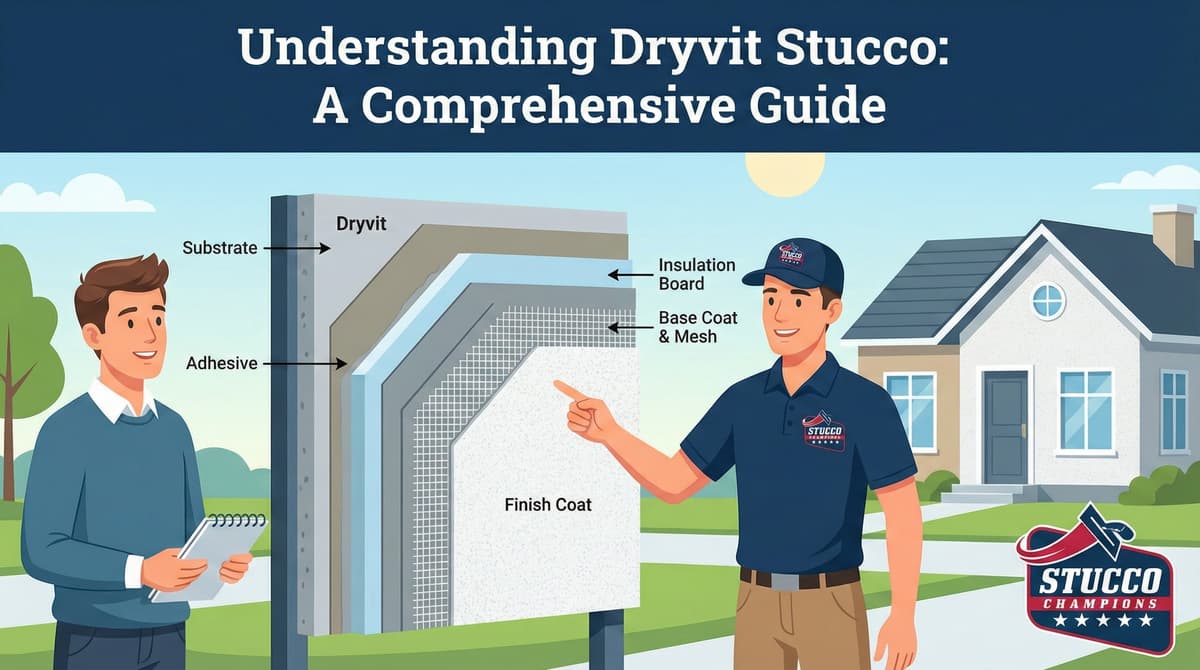
The Anatomy of EIFS
- Insulation Board: Expanded Polystyrene (EPS) foam glued to the exterior sheathing.
- Base Coat: A cementitious adhesive troweled over the foam.
- Mesh: Fiberglass grid embedded in the base coat for strength.
- Finish: A textured acrylic polymer coating (Synthetic Stucco).
Free Assessment
Noticing Stucco Damage?
Get a free on-site assessment from a licensed contractor. $0 deposit, no obligation.
GET FREE ASSESSMENT2. Dryvit vs. Traditional Stucco: The Breakdown
Dryvit manufactures materials for both systems, but they function differently physics-wise.
EIFS (Synthetic / Foam System)
Behavior: Flexible, lightweight, and highly insulating (High R-Value).
Pros: Reduces energy bills, resists cracking due to flexibility, and allows for complex architectural shapes (cornices/columns).
Cons: It is a "barrier system." If water gets behind the foam (usually via failed window caulk), it cannot evaporate. This traps moisture against the wood framing, leading to dry rot.
Traditional Hard Coat (Cement System)
Behavior: Rigid, heavy, and breathable.
Pros: Highly impact resistant (baseball proof), fire-resistant (1-hour rating), and permeable (allows the wall to breathe).
Cons: Prone to hairline cracking and offers very little insulation value.
3. How to Identify Your System
Not sure what is on your house? Perform the "Thumb Test."
- Push on the wall: If you can press your thumb into the texture and it feels slightly spongy or hollow, it is EIFS (Synthetic).
- Knock on the wall: If it hurts your knuckles and sounds like a solid rock, it is Traditional Hard Coat.
4. Modern Solutions: The New Dryvit
Technology has evolved. Dryvit now offers "Drainage EIFS," which solves the old water-trapping problem by adding a drainage plane behind the foam.
They also offer "NewBrick," a lightweight brick veneer that matches the weight of stucco but the look of masonry.
⚠️ Maintenance Warning
If your home is EIFS (Dryvit), you must maintain the sealant joints around windows and doors. Unlike traditional stucco which has building paper to shed water, EIFS relies 100% on the surface seal. If the caulk fails, the system fails.
Conclusion: Know Your Cladding
Whether you have a Dryvit EIFS system or a Dryvit Hard Coat system, maintenance is key. EIFS requires specialized acrylic coatings and rigorous sealant maintenance, while hard coat requires breathable masonry paints. Knowing the difference ensures you don't apply the wrong repair material.
Related Resources
Last week, we shared Stucco Systems: Identifying What Is On Your Home. If you are still unsure if you have EIFS or Stucco, check this guide.
Frequently Asked Questions About Stucco
How much does stucco repair cost in Orange County and Los Angeles?+
Stucco repair typically ranges from $500 for minor crack patching to $5,000+ for full re-stucco of a single elevation. The exact cost depends on the damage type (hairline cracks, water damage, delamination, weep screed failure), the square footage involved, and whether the original three-coat or one-coat stucco system needs to be matched. Stucco Champions provides fixed-price written estimates after a free on-site assessment — no hourly billing, no surprise change orders. See our stucco repair cost guide for detailed pricing by repair type.
How long does stucco last in Southern California?+
Properly installed three-coat stucco lasts 50-80+ years in Southern California's climate. The most common failure points aren't the stucco itself — they're the supporting components: corroded weep screed, deteriorated building paper behind the stucco, and improperly sealed window flashing. Most "stucco failures" are actually moisture-intrusion failures that start at one of these points. Annual visual inspection catches problems before they spread, which is why we offer free weep screed assessments for homeowners in our service area.
Can I repair stucco myself, or do I need a contractor?+
Hairline cracks under 1/8 inch wide can be sealed with elastomeric caulk by a homeowner. Anything larger — pattern cracks, delamination (where stucco pulls away from the wall), water-damaged areas, or chimney/window leak repairs — requires a licensed contractor. Improper DIY repair on these is the #1 cause of repeat failures because the underlying cause (usually moisture) isn't addressed. California's CSLB requires a license for any stucco work over $500. We're a CSLB-licensed and insured contractor — see our contractor team for credentials.
How do I know if I need stucco repair vs. full re-stucco?+
If less than 30% of an elevation has visible damage, repair is the right call. If you see large areas of cracking, multiple zones of delamination, or the underlying paper and lath have rotted across an entire wall, full re-stucco of that elevation is more cost-effective long-term. Our free assessment includes a moisture survey and lath inspection so you get a defensible recommendation either way — not just a quote pushing whichever option costs more.
Do you offer warranties on stucco work?+
Yes. Stucco Champions provides a written 5-year workmanship warranty on all stucco repairs and a 10-year warranty on full re-stucco. We're a CSLB-licensed and insured contractor (license #1122006 — verifiable at cslb.ca.gov), which means our work is backed by California's contractor licensing board, not just our own promise. Request a free estimate to see the warranty terms in writing before you sign anything.
How long does a stucco repair take?+
Most patch repairs are completed in 1-2 days, including a 24-hour cure time before texture matching and color application. Full re-stucco of a single elevation runs 5-7 working days because each coat (scratch, brown, finish) needs to cure properly before the next is applied. We schedule around weather — California stucco needs daytime temperatures above 50°F with no rain forecast for at least 24 hours after each coat. Our crew shows up on time, every time.