Master the Art of Choosing the Perfect Stucco Color

Written by Stucco Champions — Southern California’s Authority on Exterior Plastering.
The Architect’s Eye: A Technical Guide to Selecting Stucco Color
Selecting a stucco color is not the same as picking a paint swatch for your living room. Stucco is a permanent, cementitious cladding. The color is not a surface layer; it is an "integral" part of the chemistry. This means the final appearance is dictated by hydration, texture, and sunlight.
If you choose based solely on a paper chip, you will be disappointed. This guide applies architectural principles and industry realities to help you select a color that enhances your home’s value and survives the Southern California sun.
1. The Chemistry of "Mottling"
Before looking at a color chart, you must decide on the behavior of the color. Do you want it to look like stone, or like paint?
Traditional Cement Finish
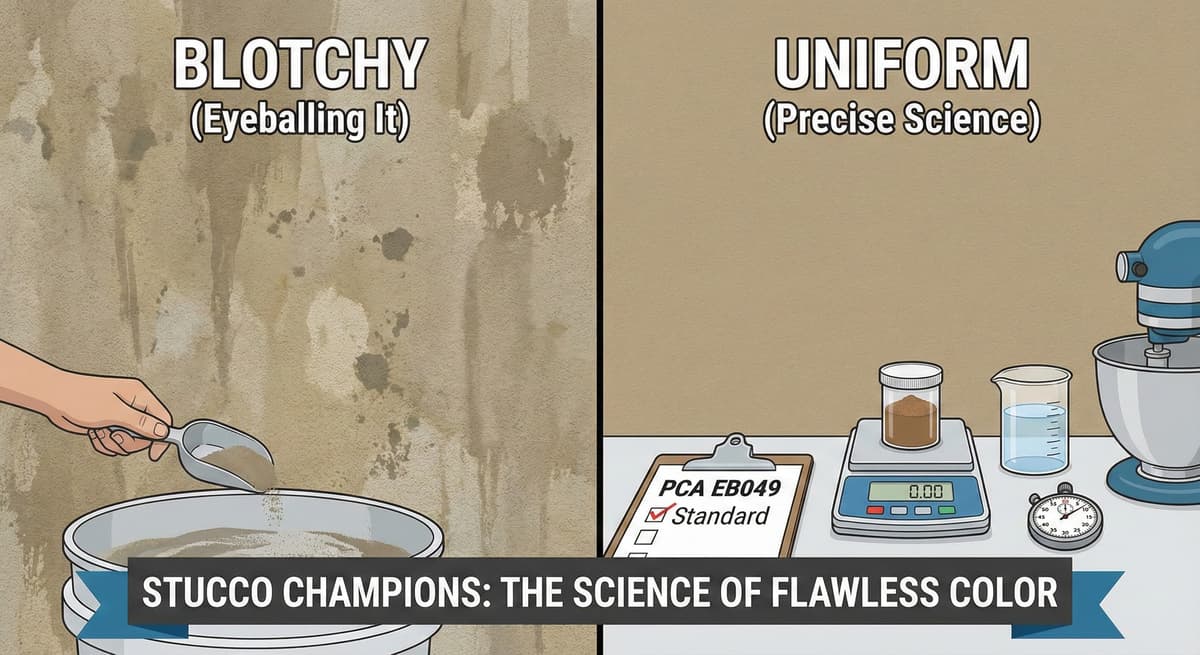
Cement is an organic material. As it cures, moisture evaporates at different rates depending on the thickness of the texture. This creates Mottling—a cloud-like variation of light and dark shades.
Best For: Spanish, Tuscan, and Santa Barbara styles. The imperfection is the aesthetic.
Acrylic (Synthetic) Finish
Acrylics are polymer-based. They dry to a perfectly uniform, flat color with zero mottling.
Best For: Modern, Contemporary, and Craftsman styles where clean, crisp lines are required.
Free Assessment
Noticing Stucco Damage?
Get a free on-site assessment from a licensed contractor. $0 deposit, no obligation.
GET FREE ASSESSMENT2. The "Paper Chart" Trap
Never trust the printed color chart.
The brochure you pick up at the supply yard is printed with ink on glossy paper. Stucco is a matte, rough material made of sand and cement. The texture absorbs light, while the paper reflects it.
The Rule: Actual stucco will almost always appear darker and richer on the wall than it does on the paper chart due to the shadows cast by the sand texture.
3. The Wet Sample Protocol
You must see the material on the wall before committing to 3,000 square feet of it. We recommend a "Mock-Up" process:
- Select 3 Shades: Choose your target color, one shade lighter, and one shade darker.
- Apply 2' x 2' Samples: We apply these directly to a discreet section of your wall or a sample board.
- The 24-Hour Wait: This is non-negotiable. Wet stucco is 3-4 shades darker than dry stucco. You must let it cure overnight to see the true "bleached out" final tone.
4. The Solar Reality: Dark Colors in SoCal
In Newport Beach and the inland valleys, UV exposure is intense. This creates two problems for dark colors (Charcoal, Navy, Deep Greens):
- Rapid Fading: Traditional cement pigments (Iron Oxide) are stable, but organic dark pigments fade quickly. A black cement wall will turn battleship grey in 3-5 years.
- Thermal Stress: Dark walls absorb massive heat. This causes rapid expansion and contraction, leading to hairline cracks.
⚠️ The Dark Color Solution
If you absolutely want a dark exterior, you must use an Acrylic Finish with high-performance inorganic pigments. Do not attempt a dark finish with traditional cement; it will mottle unevenly and fade irregularly.
5. Coordinating with Fixed Elements
Stucco does not exist in a vacuum. To achieve "Curb Appeal," the color must harmonize with the elements you cannot change:
- The Roof: If you have a Red Clay Tile roof (warm), avoid "Cool Greys" or "Blues." Stick to Warm Creams, Beiges, and Terra Cottas. If you have a Charcoal Shingle roof, Cool Greys and Whites work perfectly.
- The Hardscape: Ensure the stucco undertone doesn't clash with your pavers or driveway stone.
6. Custom Matching Limitations
We can custom match almost any color (e.g., Benjamin Moore "Revere Pewter"), but there are logistics to consider:
- Lead Time: Custom lab samples take 2-3 weeks to formulate.
- Batch Sizing: Custom colors must be ordered in batch quantities sufficient for the whole house to ensure consistency. You cannot just run to the store for "one more bag."
Conclusion: Trust the Process
Choosing a color is subjective; ensuring that color performs for 20 years is objective science. By understanding the limitations of the material—whether cement or acrylic—you can select a palette that looks beautiful on day one and day 5,000.
Related Resources
Last week, we shared Strategic Placement of Stucco Control Joints. Planning your color and your control joints together is the key to a flawless facade.
Frequently Asked Questions About Stucco
How much does stucco repair cost in Orange County and Los Angeles?+
Stucco repair typically ranges from $500 for minor crack patching to $5,000+ for full re-stucco of a single elevation. The exact cost depends on the damage type (hairline cracks, water damage, delamination, weep screed failure), the square footage involved, and whether the original three-coat or one-coat stucco system needs to be matched. Stucco Champions provides fixed-price written estimates after a free on-site assessment — no hourly billing, no surprise change orders. See our stucco repair cost guide for detailed pricing by repair type.
How long does stucco last in Southern California?+
Properly installed three-coat stucco lasts 50-80+ years in Southern California's climate. The most common failure points aren't the stucco itself — they're the supporting components: corroded weep screed, deteriorated building paper behind the stucco, and improperly sealed window flashing. Most "stucco failures" are actually moisture-intrusion failures that start at one of these points. Annual visual inspection catches problems before they spread, which is why we offer free weep screed assessments for homeowners in our service area.
Can I repair stucco myself, or do I need a contractor?+
Hairline cracks under 1/8 inch wide can be sealed with elastomeric caulk by a homeowner. Anything larger — pattern cracks, delamination (where stucco pulls away from the wall), water-damaged areas, or chimney/window leak repairs — requires a licensed contractor. Improper DIY repair on these is the #1 cause of repeat failures because the underlying cause (usually moisture) isn't addressed. California's CSLB requires a license for any stucco work over $500. We're a CSLB-licensed and insured contractor — see our contractor team for credentials.
How do I know if I need stucco repair vs. full re-stucco?+
If less than 30% of an elevation has visible damage, repair is the right call. If you see large areas of cracking, multiple zones of delamination, or the underlying paper and lath have rotted across an entire wall, full re-stucco of that elevation is more cost-effective long-term. Our free assessment includes a moisture survey and lath inspection so you get a defensible recommendation either way — not just a quote pushing whichever option costs more.
Do you offer warranties on stucco work?+
Yes. Stucco Champions provides a written 5-year workmanship warranty on all stucco repairs and a 10-year warranty on full re-stucco. We're a CSLB-licensed and insured contractor (license #1122006 — verifiable at cslb.ca.gov), which means our work is backed by California's contractor licensing board, not just our own promise. Request a free estimate to see the warranty terms in writing before you sign anything.
How long does a stucco repair take?+
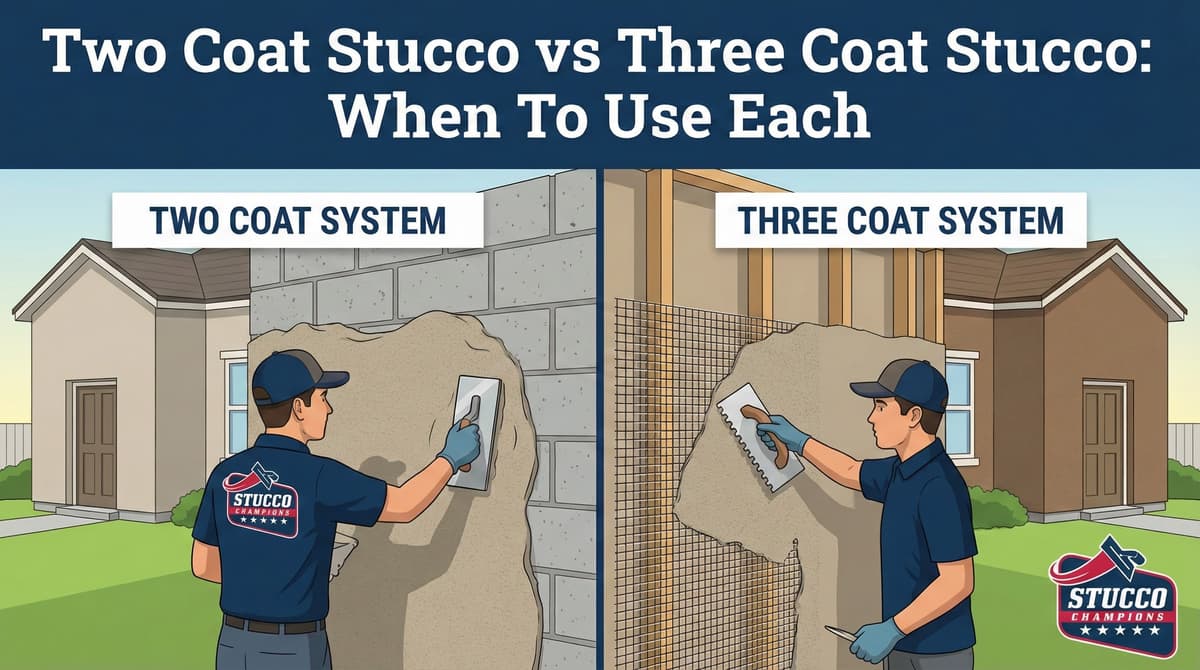
Most patch repairs are completed in 1-2 days, including a 24-hour cure time before texture matching and color application. Full re-stucco of a single elevation runs 5-7 working days because each coat (scratch, brown, finish) needs to cure properly before the next is applied. We schedule around weather — California stucco needs daytime temperatures above 50°F with no rain forecast for at least 24 hours after each coat. Our crew shows up on time, every time.