5 Common Stucco Problems and How to Prevent Them
Written by Stucco Champions — Southern California’s Authority on Exterior Plastering.
Stucco Problems and How to Prevent Them: A Diagnostic Guide
Stucco is the dominant exterior finish in Southern California for a reason: it is fire-resistant, durable, and beautiful. However, it is not invincible. Seismic shifts, thermal expansion, and moisture intrusion can compromise the integrity of the system.
The key to avoiding expensive repairs is early detection. At Stucco Champions, we believe an educated homeowner is our best partner. This guide breaks down the most common failure points—from hairline fractures to efflorescence—and the technical protocols required to fix them correctly.
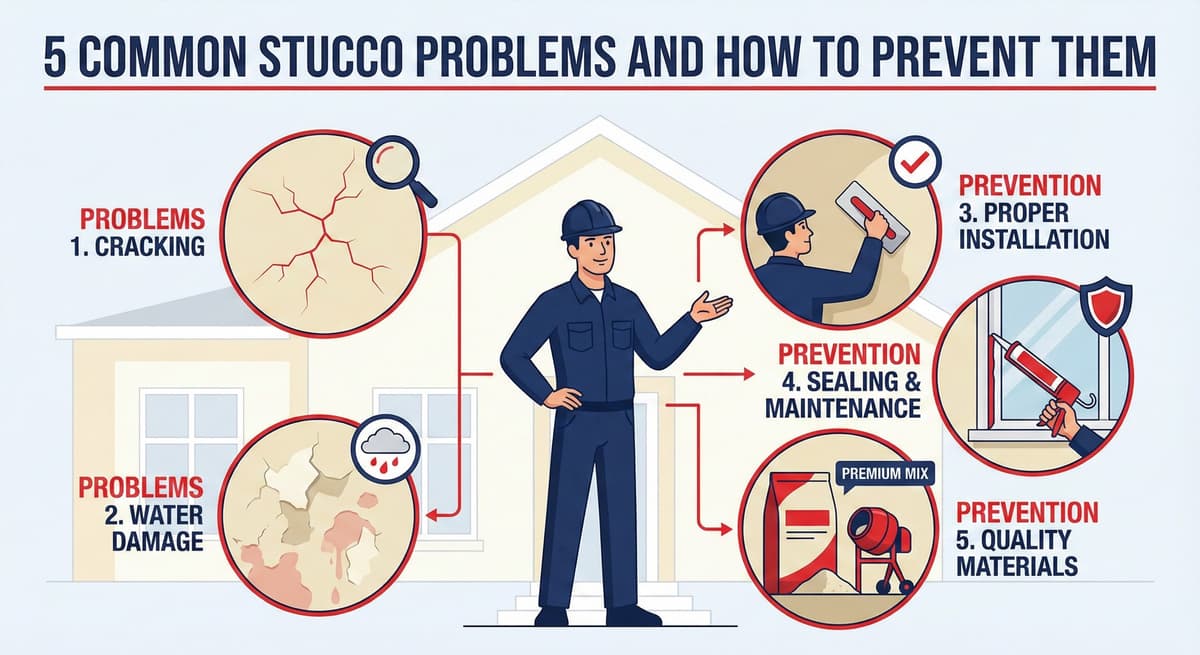
1. The Crack Spectrum: Cosmetic vs. Structural
Not all cracks are created equal. Understanding the difference can save you thousands.
Free Assessment
Noticing Stucco Damage?
Get a free on-site assessment from a licensed contractor. $0 deposit, no obligation.
GET FREE ASSESSMENTHairline Cracks (< 1/16")
Appearance: Thin, spiderweb-like lines.
Cause: Normal hydration shrinkage during curing or minor thermal expansion.
The Fix: Clean the area and apply a high-quality elastomeric or acrylic-based patch.
[Image of sand grain size comparison]
(Note: Use fine aggregate for smooth walls). Never use silicone; paint will not stick to it.
Structural Cracks (> 1/8")
Appearance: Wide cracks, often running diagonally from windows or doors, or vertically from the foundation.
Cause: Foundation settling, seismic movement, or lack of "butterfly" lath reinforcement at corners.
The Fix: This requires surgical repair. We "V-cut" the crack to open it up, install new fiberglass mesh for reinforcement, and apply a polymer-modified base coat before blending the texture.
2. Moisture Symptoms: Stains & Efflorescence
Water is the enemy of the wood framing behind your stucco. The wall often gives you warning signs before the rot sets in.
Efflorescence (The White Powder)
What it is: Soluble salts leaching out of the cement.
The Cause: Moisture migration. It means water is getting behind the stucco (perhaps from a sprinkler hitting the wall) and evaporating through the face.
The Fix: Do not just paint over it. Scrub with a stiff bristle brush and a mild vinegar solution. Most importantly: Eliminate the moisture source.
Rust Stains (Rust Jacking)
What it is: Brown or orange streaks bleeding through the finish.
The Cause: The galvanized metal lath inside the wall is corroding. As steel rusts, it expands, cracking the stucco.
The Fix: This is a structural issue requiring a professional stucco patch. We must excise the rusted metal and tie in new lath.
3. Delamination: Bulging and Soft Spots
If you see a section of the wall that looks like a blister or feels spongy when pressed, you have Delamination.
The Reality: The bond between the stucco layers (or between the stucco and the lath) has failed. Gravity is now the only thing holding that section up.
The Fix: Removal is mandatory. We strip the delaminated area down to the studs, inspect the sheathing for rot, and rebuild the system from the paper up.
4. Diagnostic Matrix: Troubleshoot Your Wall
Use this reference table to identify your issue and gauge the urgency.
| Problem | Likely Cause | Recommended Solution | Urgency |
|---|---|---|---|
| Hairline Cracks | Settling, Shrinkage | Elastomeric Patch | Low (Monitor) |
| Structural Cracks | Movement, Poor Lathing | Mesh Reinforcement & Patch | High |
| Efflorescence | Moisture Migration | Identify Leak & Clean | Medium |
| Rust Stains | Corroded Lath | Cut-Out Repair | High |
| Bulging/Blisters | Delamination/Rot | Full Removal & Re-Stucco | Critical |
5. When to Call a Professional
DIY Territory: Minor hairline cracks and cleaning surface stains.
Professional Territory: Any crack wider than a credit card, bulging walls, or rust stains. These involve the waterproofing envelope. If you patch these incorrectly, you trap moisture inside, accelerating dry rot.
Cost Expectations
Minor Repairs: $650 – $1,000 (Mobilization minimums apply).
Structural Repairs: $1,500+ depending on rot discovery.
Full Restucco: The ultimate fix for widespread failure. Read about Restuccoing Your Home.
Conclusion: Maintenance is Prevention
Stucco is low maintenance, not no maintenance. An annual inspection and soft wash can extend the life of your exterior by decades. If you spot a problem, address it early. A $800 patch today prevents a $15,000 framing repair tomorrow.
Related Resources
Last week, we shared How to Remove Stubborn White Stucco Stains. Learn the chemistry of cleaning efflorescence safely.
Frequently Asked Questions About Stucco
How much does stucco repair cost in Orange County and Los Angeles?+
Stucco repair typically ranges from $500 for minor crack patching to $5,000+ for full re-stucco of a single elevation. The exact cost depends on the damage type (hairline cracks, water damage, delamination, weep screed failure), the square footage involved, and whether the original three-coat or one-coat stucco system needs to be matched. Stucco Champions provides fixed-price written estimates after a free on-site assessment — no hourly billing, no surprise change orders. See our stucco repair cost guide for detailed pricing by repair type.
How long does stucco last in Southern California?+
Properly installed three-coat stucco lasts 50-80+ years in Southern California's climate. The most common failure points aren't the stucco itself — they're the supporting components: corroded weep screed, deteriorated building paper behind the stucco, and improperly sealed window flashing. Most "stucco failures" are actually moisture-intrusion failures that start at one of these points. Annual visual inspection catches problems before they spread, which is why we offer free weep screed assessments for homeowners in our service area.
Can I repair stucco myself, or do I need a contractor?+
Hairline cracks under 1/8 inch wide can be sealed with elastomeric caulk by a homeowner. Anything larger — pattern cracks, delamination (where stucco pulls away from the wall), water-damaged areas, or chimney/window leak repairs — requires a licensed contractor. Improper DIY repair on these is the #1 cause of repeat failures because the underlying cause (usually moisture) isn't addressed. California's CSLB requires a license for any stucco work over $500. We're a CSLB-licensed and insured contractor — see our contractor team for credentials.
How do I know if I need stucco repair vs. full re-stucco?+
If less than 30% of an elevation has visible damage, repair is the right call. If you see large areas of cracking, multiple zones of delamination, or the underlying paper and lath have rotted across an entire wall, full re-stucco of that elevation is more cost-effective long-term. Our free assessment includes a moisture survey and lath inspection so you get a defensible recommendation either way — not just a quote pushing whichever option costs more.
Do you offer warranties on stucco work?+
Yes. Stucco Champions provides a written 5-year workmanship warranty on all stucco repairs and a 10-year warranty on full re-stucco. We're a CSLB-licensed and insured contractor (license #1122006 — verifiable at cslb.ca.gov), which means our work is backed by California's contractor licensing board, not just our own promise. Request a free estimate to see the warranty terms in writing before you sign anything.
How long does a stucco repair take?+
Most patch repairs are completed in 1-2 days, including a 24-hour cure time before texture matching and color application. Full re-stucco of a single elevation runs 5-7 working days because each coat (scratch, brown, finish) needs to cure properly before the next is applied. We schedule around weather — California stucco needs daytime temperatures above 50°F with no rain forecast for at least 24 hours after each coat. Our crew shows up on time, every time.