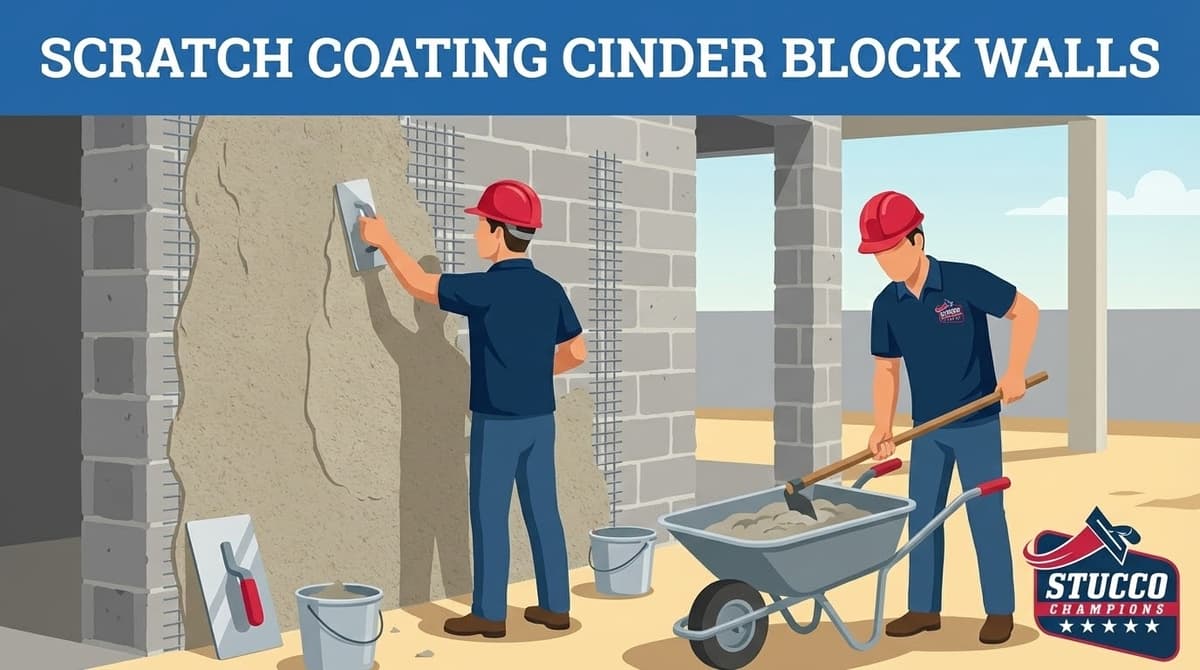
Scratch Coating Cinder Block Walls
Written by Stucco Champions — Southern California’s Authority on Exterior Plastering.
How to Stucco Over Cinderblock Wall: The Direct-Apply Method
Stuccoing a cinder block (CMU) wall is fundamentally different from stuccoing a wood-framed house. There is no wire lath, no building paper, and no staples. Instead, you are bonding cement to cement.
The success of this project depends entirely on the mechanical and chemical bond between the new stucco and the existing block. If this bond fails, the stucco will delaminate (sheet off) in large chunks. This guide outlines the ASTM C926 protocol for direct-applied Portland cement plaster over masonry.
1. Assess the Surface: Painted vs. Raw
Before you mix a single bag, you must determine the condition of the block.
⚠️ The Paint Danger
Stucco will NOT stick to paint or sealer.
If the block wall is painted, you cannot apply stucco directly over it. You must either:
1. Sandblast the paint off to expose the raw aggregate.
2. Install metal lath over the paint to create a new mechanical key (essentially treating it like a wood wall).
Free Assessment
Noticing Stucco Damage?
Get a free on-site assessment from a licensed contractor. $0 deposit, no obligation.
GET FREE ASSESSMENT2. Preparation: The Water Test
If the wall is raw block, it must be porous.
The Test: Splash a cup of water on the dry wall.
If it absorbs and darkens immediately: The pores are open and ready for bonding.
If it beads up: There is an invisible sealer (like silicone) present. You must grind or sandblast the surface.
3. The Bonding Agent (The Glue)
Even on clean block, we recommend a bonding agent to ensure uniform suction. You have two professional options:
- Liquid Bond (Weld-Crete): A chemical adhesive rolled onto the block. It stays tacky for several days, gluing the new cement to the old.
- Dash Coat: A slurry of cement and sand mixed with a liquid acrylic additive, splattered onto the wall with a hopper gun. This creates a rough, sandpaper-like surface for the base coat to grip.
4. The Two-Coat Application Strategy
For block walls, a "Two-Coat" system is standard. You do not typically need a separate scratch and brown coat unless you are trying to straighten a very crooked wall.
Step A: The Fiber-Reinforced Base Coat
Material: Use a Fiber-Reinforced Stucco Base (like Omega or Quikrete Fiberglass Reinforced Stucco). The fibers act like internal rebar to prevent cracking over the grout lines.
Application: Trowel the material onto the block, applying high pressure to force it into the pores.
Thickness: Aim for 3/8 inch. This is enough to cover the mortar joints ("telegraphing") so the grid pattern doesn't show through the finish.
Step B: The Cure (Hydration)
Block walls are thirsty. They will suck the water out of your wet stucco instantly, causing it to crack.
The Protocol: You must mist the base coat with water twice a day for 48 hours. This keeps the cement hydrated so it reaches full strength.
Step C: The Finish Coat
After the base coat has cured (minimum 7 days), apply the final 1/8" texture coat using a factory-blended color finish (LaHabra/Omega). Float it to your desired texture (Sand or Lace).
5. Critical Details: Joints and Caps
Ignoring these details ensures failure:
- Control Joints: If the wall is long, you should install a vertical control joint every 20 feet. Block walls expand in the heat; without a joint, the stucco will crack vertically.
- The Cap: Never just stucco the flat top of a wall. Standing water will penetrate and pop the face off. Always install a concrete cap, stone veneer cap, or metal coping to shed water.
Conclusion: It’s About the Bond
Stuccoing over block is a great way to upgrade a garden wall or garage, but you must respect the substrate. Clean it, bond it, and keep it wet while it cures. If you skip the prep, gravity will eventually pull your new stucco right off the wall.
Related Resources
Last week, we shared Scratch Coat Stucco Guide: Purpose and Mix. Learn more about the base coat materials used in this process.
Frequently Asked Questions About Stucco
How much does stucco repair cost in Orange County and Los Angeles?+
Stucco repair typically ranges from $500 for minor crack patching to $5,000+ for full re-stucco of a single elevation. The exact cost depends on the damage type (hairline cracks, water damage, delamination, weep screed failure), the square footage involved, and whether the original three-coat or one-coat stucco system needs to be matched. Stucco Champions provides fixed-price written estimates after a free on-site assessment — no hourly billing, no surprise change orders. See our stucco repair cost guide for detailed pricing by repair type.
How long does stucco last in Southern California?+
Properly installed three-coat stucco lasts 50-80+ years in Southern California's climate. The most common failure points aren't the stucco itself — they're the supporting components: corroded weep screed, deteriorated building paper behind the stucco, and improperly sealed window flashing. Most "stucco failures" are actually moisture-intrusion failures that start at one of these points. Annual visual inspection catches problems before they spread, which is why we offer free weep screed assessments for homeowners in our service area.
Can I repair stucco myself, or do I need a contractor?+
Hairline cracks under 1/8 inch wide can be sealed with elastomeric caulk by a homeowner. Anything larger — pattern cracks, delamination (where stucco pulls away from the wall), water-damaged areas, or chimney/window leak repairs — requires a licensed contractor. Improper DIY repair on these is the #1 cause of repeat failures because the underlying cause (usually moisture) isn't addressed. California's CSLB requires a license for any stucco work over $500. We're a CSLB-licensed and insured contractor — see our contractor team for credentials.
How do I know if I need stucco repair vs. full re-stucco?+
If less than 30% of an elevation has visible damage, repair is the right call. If you see large areas of cracking, multiple zones of delamination, or the underlying paper and lath have rotted across an entire wall, full re-stucco of that elevation is more cost-effective long-term. Our free assessment includes a moisture survey and lath inspection so you get a defensible recommendation either way — not just a quote pushing whichever option costs more.
Do you offer warranties on stucco work?+
Yes. Stucco Champions provides a written 5-year workmanship warranty on all stucco repairs and a 10-year warranty on full re-stucco. We're a CSLB-licensed and insured contractor (license #1122006 — verifiable at cslb.ca.gov), which means our work is backed by California's contractor licensing board, not just our own promise. Request a free estimate to see the warranty terms in writing before you sign anything.
How long does a stucco repair take?+
Most patch repairs are completed in 1-2 days, including a 24-hour cure time before texture matching and color application. Full re-stucco of a single elevation runs 5-7 working days because each coat (scratch, brown, finish) needs to cure properly before the next is applied. We schedule around weather — California stucco needs daytime temperatures above 50°F with no rain forecast for at least 24 hours after each coat. Our crew shows up on time, every time.