Discover the Versatility of Stucco Trowels: A Complete Guide
Written by Stucco Champions — Southern California’s Authority on Exterior Plastering.
Different Stucco Trowels and Their Guide: The Extension of the Hand
In the trade of plastering, the trowel is not just a tool; it is an extension of the artisan's hand. The texture, smoothness, and density of your stucco wall are determined entirely by the piece of steel pushing the mud. Using the wrong trowel can result in "chatter marks," rust stains, or uneven hydration.
Whether you are a DIYer patching a crack or an apprentice learning the ropes, understanding the metallurgy and geometry of your tools is critical. This guide breaks down the essential trowels used in Southern California stucco application.
1. Metallurgy: Choosing the Right Steel
Trowels are forged from different metals. Each reacts differently to the chemistry of Portland cement.
Free Assessment
Noticing Stucco Damage?
Get a free on-site assessment from a licensed contractor. $0 deposit, no obligation.
GET FREE ASSESSMENTStainless Steel (The Finisher)
Best For: White or light-colored finish coats.
Why? It does not rust. If you use a standard carbon steel trowel on a white "Santa Barbara" finish, microscopic rust particles can embed in the wall, leaving orange streaks months later. Stainless steel eliminates this risk. It keeps its shape and is easy to clean.
Blue Steel (The Burnisher)
Best For: Hard-troweled smooth finishes and interior plaster.
Why? Blue steel is thinner and more flexible than stainless. It allows the plasterer to "feel" the wall and apply extreme pressure to burnish (polish) the surface without leaving drag marks.
Note: It rusts easily if not oiled after every use.
High Carbon Steel (The Workhorse)
Best For: Base coats (Scratch and Brown).
Why? It is incredibly durable and rigid. It can handle the heavy abrasion of coarse sand used in base coats. Since the base coat gets covered, minor rust spots are not a concern.
2. Blade Shapes: Square vs. Rounded
The shape of the blade dictates how the mud is manipulated.
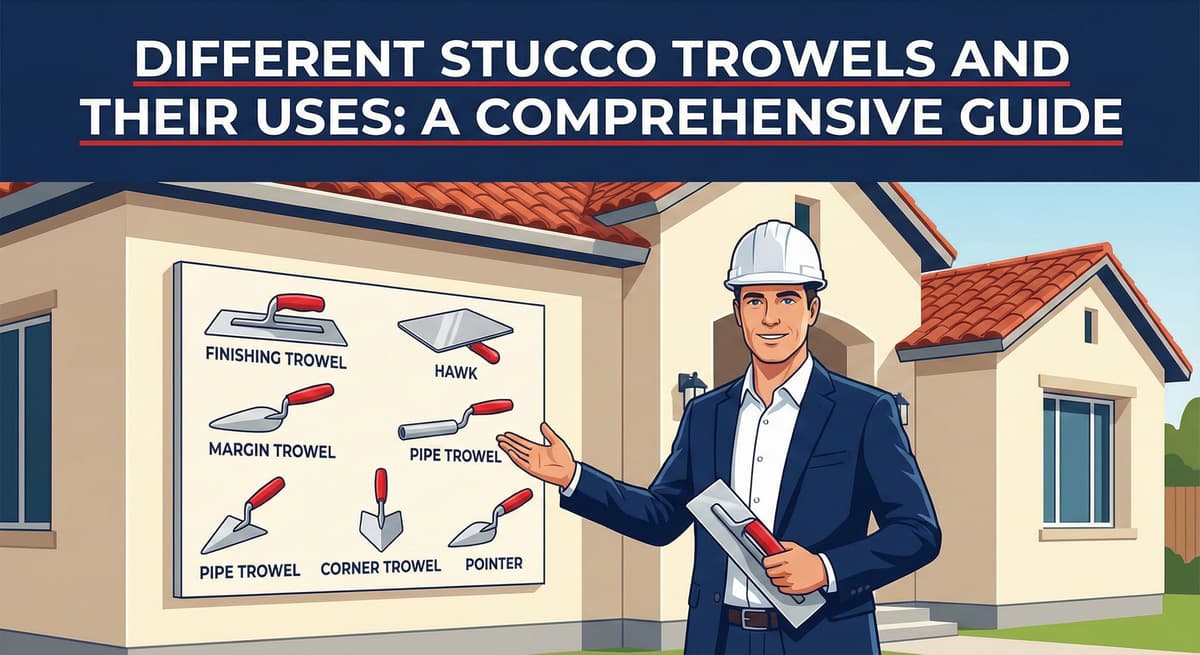
The Square Trowel (Pipe Trowel)
The Look: Rectangular with sharp 90-degree corners.
Use: Applying base coats, laying material into corners, and "rodding" small areas.
Drawback: The sharp corners can dig into the finish, creating "cat faces" or gouges if the user isn't careful.
The Pool Trowel (Rounded)
The Look: Rectangular with rounded, curved ends (like a pill shape).
Use: Finish coats and smooth textures.
Why We Love It: The rounded ends prevent the tool from digging in. This allows the plasterer to make sweeping arcs without leaving "lap marks" or lines in the texture. Despite the name, it is the standard tool for modern smooth stucco, not just swimming pools.
3. Detail Tools: Getting into the Corners
You cannot finish a house with just a 14-inch trowel.
- Margin Trowel: The small, rectangular "bucket scoop." Essential for mixing small batches, cleaning the hawk, and patching tight areas around pipes.
- Pointing Trowel: Triangular shape. Used for detailed repair work and getting into sharp internal angles.
- Corner Trowel: Shaped like an "L." Used to create perfect 90-degree inside or outside corners.
4. The Hawk: The Material Holder
You can't trowel without a hawk. This is the flat square board that holds your mortar.
Recommendation: Buy Magnesium. It is lighter than aluminum and durable. In plastering, saving a few ounces of weight on your arm makes a massive difference over an 8-hour day.
⚠️ Handle Ergonomics
Don't ignore the handle.
Wood (Camel Back): Traditional choice. Absorbs sweat, preventing blisters.
Soft-Grip (Rubber): Reduces vibration and fatigue, but can get slippery when wet.
We recommend natural wood handles (like Camelot or leather-wrapped) for long-term comfort.
5. Breaking in a New Trowel
A brand new trowel is often too sharp. The edges can slice the building paper or leave razor-thin lines in the mud.
Pro Tip: Before using a new trowel on a finish coat, sand the edges lightly or use it on a rough base coat for a few days to dull the "factory edge."
Conclusion: The Right Tool for the Layer
Use Carbon Steel/Square Trowels for the structural gray coats to move heavy mud. Switch to Stainless Steel/Pool Trowels for the white finish coats to ensure a clean, rust-free, smooth texture. Using the right metal for the right layer is the mark of a professional.
Related Resources
Last week, we shared Fog Coating vs. Painting Stucco. If your finish troweling didn't come out perfect, fog coating can help blend the texture.
Frequently Asked Questions About Stucco
How much does stucco repair cost in Orange County and Los Angeles?+
Stucco repair typically ranges from $500 for minor crack patching to $5,000+ for full re-stucco of a single elevation. The exact cost depends on the damage type (hairline cracks, water damage, delamination, weep screed failure), the square footage involved, and whether the original three-coat or one-coat stucco system needs to be matched. Stucco Champions provides fixed-price written estimates after a free on-site assessment — no hourly billing, no surprise change orders. See our stucco repair cost guide for detailed pricing by repair type.
How long does stucco last in Southern California?+
Properly installed three-coat stucco lasts 50-80+ years in Southern California's climate. The most common failure points aren't the stucco itself — they're the supporting components: corroded weep screed, deteriorated building paper behind the stucco, and improperly sealed window flashing. Most "stucco failures" are actually moisture-intrusion failures that start at one of these points. Annual visual inspection catches problems before they spread, which is why we offer free weep screed assessments for homeowners in our service area.
Can I repair stucco myself, or do I need a contractor?+
Hairline cracks under 1/8 inch wide can be sealed with elastomeric caulk by a homeowner. Anything larger — pattern cracks, delamination (where stucco pulls away from the wall), water-damaged areas, or chimney/window leak repairs — requires a licensed contractor. Improper DIY repair on these is the #1 cause of repeat failures because the underlying cause (usually moisture) isn't addressed. California's CSLB requires a license for any stucco work over $500. We're a CSLB-licensed and insured contractor — see our contractor team for credentials.
How do I know if I need stucco repair vs. full re-stucco?+
If less than 30% of an elevation has visible damage, repair is the right call. If you see large areas of cracking, multiple zones of delamination, or the underlying paper and lath have rotted across an entire wall, full re-stucco of that elevation is more cost-effective long-term. Our free assessment includes a moisture survey and lath inspection so you get a defensible recommendation either way — not just a quote pushing whichever option costs more.
Do you offer warranties on stucco work?+
Yes. Stucco Champions provides a written 5-year workmanship warranty on all stucco repairs and a 10-year warranty on full re-stucco. We're a CSLB-licensed and insured contractor (license #1122006 — verifiable at cslb.ca.gov), which means our work is backed by California's contractor licensing board, not just our own promise. Request a free estimate to see the warranty terms in writing before you sign anything.
How long does a stucco repair take?+
Most patch repairs are completed in 1-2 days, including a 24-hour cure time before texture matching and color application. Full re-stucco of a single elevation runs 5-7 working days because each coat (scratch, brown, finish) needs to cure properly before the next is applied. We schedule around weather — California stucco needs daytime temperatures above 50°F with no rain forecast for at least 24 hours after each coat. Our crew shows up on time, every time.